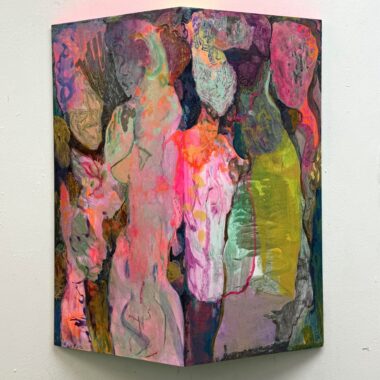
My early work, 1950s/60s, grew out of great admiration for C. Permeke, Picasso, Cubists and especially Goya’s Black paintings whose horizontal format continues to intrigue and challenge me.
Early subject matter: single monumental figures developed into manic dancing groups that then disintegrated, also my first landscapes. At this time an internal battle between the orthodoxies of American abstract expressionism and ideas of significant form and content had begun to surface and led to my wilderness years and a change of medium from oil to acrylic.
In the early 1980s a crucial turning point came with a series of works ‘Reflections after Las Meninas’, an attempt to reconcile opposing elements of abstraction/figuration, illusion/allusion, past/present. A door opened to a host of possible visual ideas.
These range from depictions of space as in mirrors, doorways, land/seascapes to mental and diagrammatic space. Presently I am working with ideas of wind, water, turbulence, the mind in the process of perceiving and some playful maverick perversities.
Works are from 20 – 675 cms, are stained, collaged and textured on canvas or wood.